NgeMood
NgeMood is a web-based application that helps users understand their emotional state through facial and text analysis.
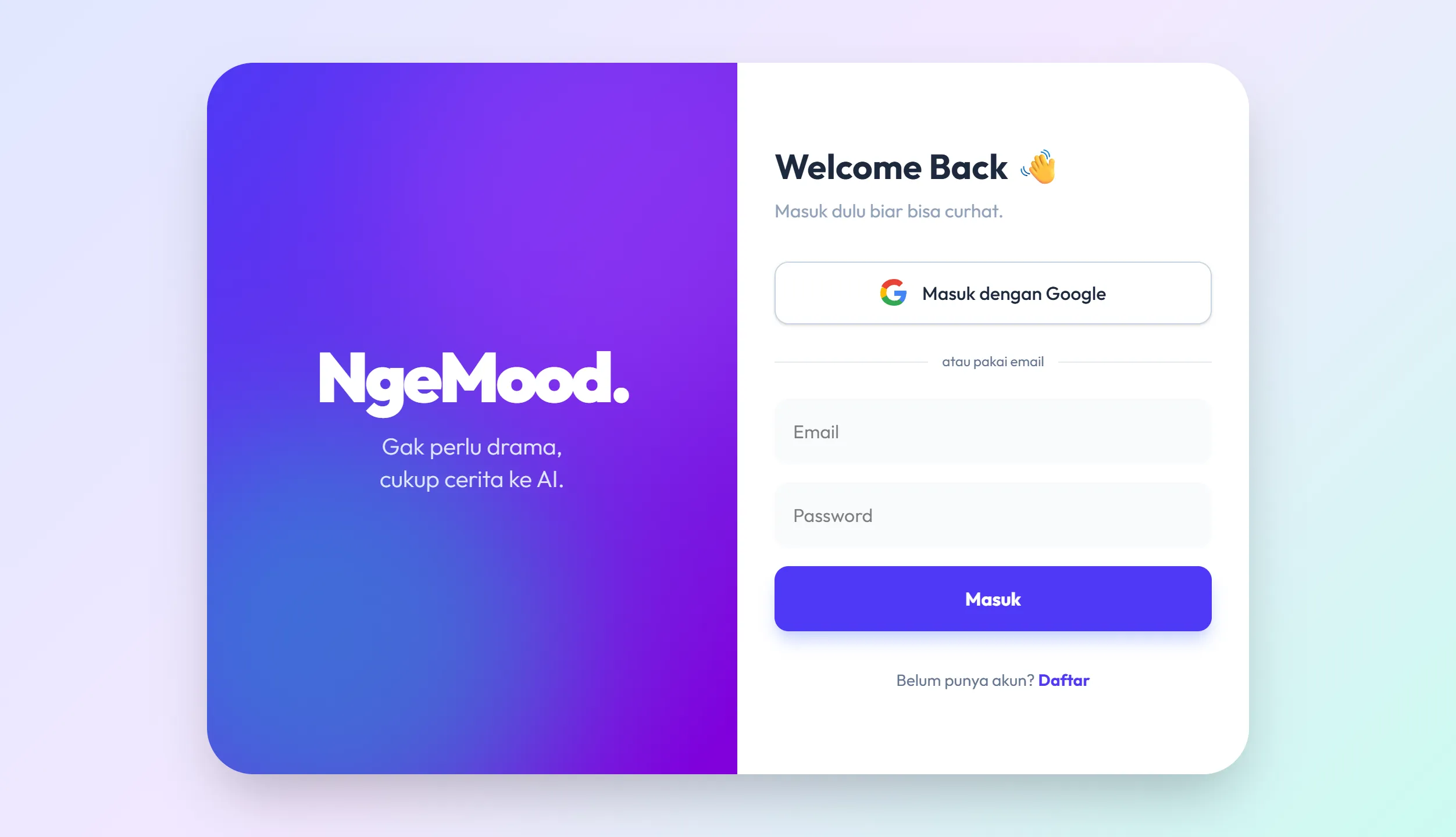
Description
NgeMood is a web-based application designed to help users understand their emotional conditions through facial analysis and text-based Artificial Intelligence.
This platform integrates computer vision, natural language processing, and generative AI into a unified system to present a personal, interactive, and data-driven self-reflection experience.
Background
Mental health issues are becoming increasingly relevant, especially among students and young generations. However, many individuals still struggle to recognize, understand, and reflect on their emotional conditions consistently.
Most emotions are only felt momentarily without any recording or further analysis, making it difficult to understand long-term emotional patterns.
NgeMood was developed as a technology-based solution to help users build better self-awareness by leveraging AI in analyzing facial expressions and journal texts, providing contextual and easy-to-understand insights.
Key Features
Facial emotion detection using deep learning models (facial emotion recognition)
Sentiment analysis from journal texts using AI
Interactive journaling with contextual and relatable AI responses
Mood history and emotional trend visualization
Activity recommendations based on emotional conditions
User authentication and management system
Interactive dashboard for monitoring emotional conditions
Roles & Contributions
Developing the system end-to-end (Machine Learning, Backend, and Frontend)
Training and integrating AI models for facial emotion detection using TensorFlow
Implementing computer vision pipelines (face detection, preprocessing, inference)
Developing backend API using FastAPI for handling authentication, data, and AI inference
Integrating generative AI (LLM) for journal text analysis and contextual response generation
Building an interactive frontend using Next.js with a focus on user experience
Designing an integrated system architecture between AI, backend, and frontend
Managing data flow from user input (camera & text) to analysis results in real-time
Optimizing system performance to ensure low latency during inference
Impact & Results
Presenting a digital solution to enhance emotional awareness based on AI
Helping users understand emotional patterns through historical data and automatic analysis
Combining AI technology and human-centered approaches in one platform
Implementing a real-world end-to-end AI system in the mental health domain